

Car Shows on LiveJudge
Contestants deserve nothing less than professional software, fair judging and efficiently run contests. Does your scoring process fall short?
Is Your Event Trapped Inside an Outdated Scoring System?
by LiveJudge Staff
The Trap: “We’ve been scoring this way for years.”
Whether you are running a classic car show or a hot rod event, chances are you are using paper scoresheets for part or all of your judging. If your event is more advanced, maybe your scorekeeper is transcribing tallies into a laptop. On the surface, scoring traditions like this seem just fine. It always worked, so why change Math is math, after all, right?
Wrong.
This article will reveal the hidden pitfalls in traditional scoring systems and ways to not only improve efficiency and accuracy, but also to leverage the LiveJudge scoring system to engage spectators and generate incremental revenue at your next auto gathering.
It Begins & Ends With Paper
Virtually all systems built for the car show and concours industries have roots in paper scoring. This fact, along, makes those systems less than optimal for both judges and contestants. The reason for this is quite simple: people don’t do math well.
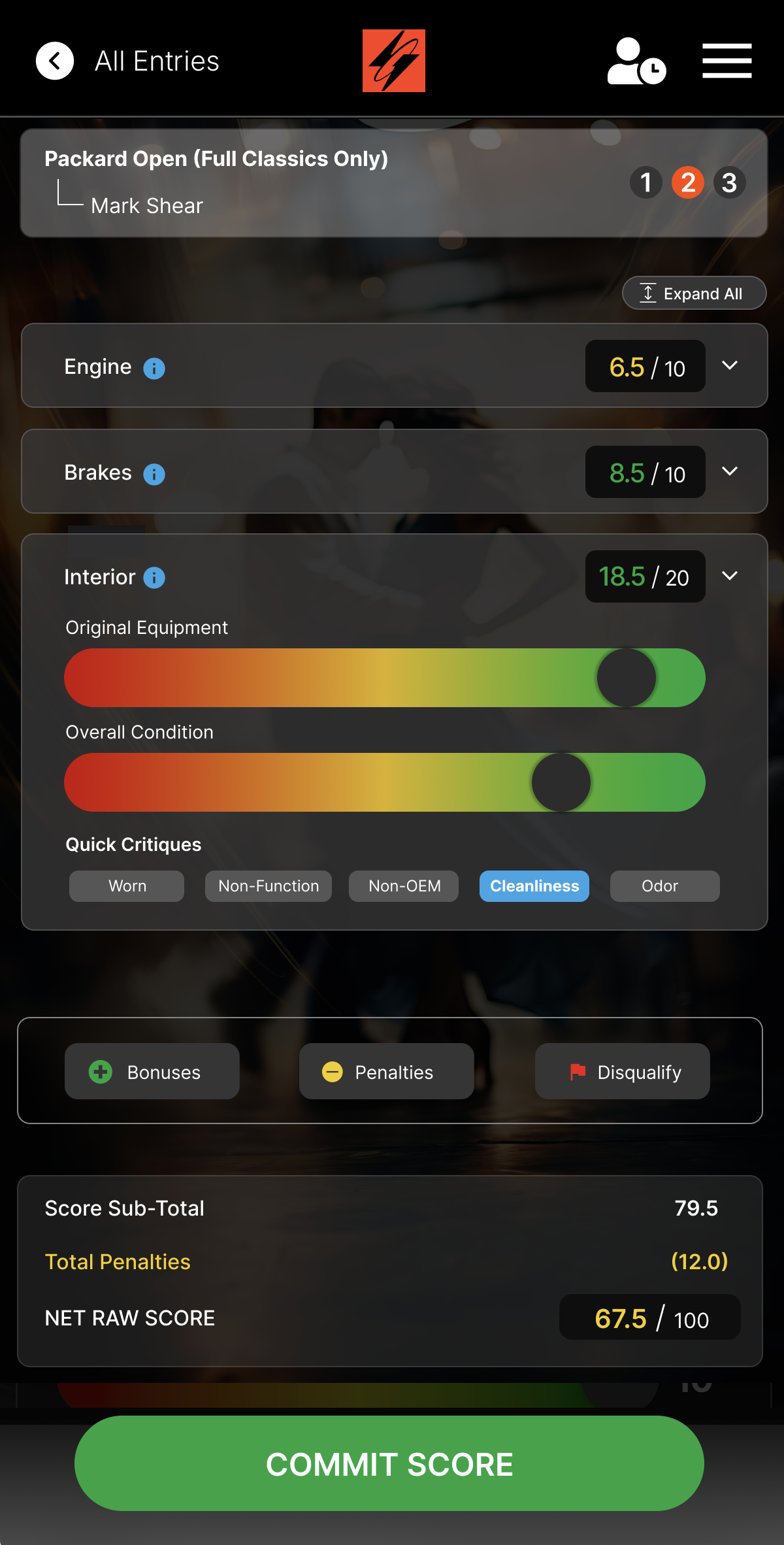
With paper scoresheets, a scoring rubric almost always has different point values for each judging factor (e.g. 15 points for one element, 10 points for another, etc.). This is the simplest way — on paper anyway — to assign relative importance to each factor. Although simple in practice, the result of this type of rubric is a less precise, blunt-instrument approach to many of your evaluating factors. Moreover, it taxes judges, who must quickly jump from one point range to the next. People intuitively understand the classic “1-10” or “1-100” ranges and can efficiently assign scores based on them. But ranges like 1-15 or 1-5 are not intuitive. LiveJudge translates a show’s multi-range scoresheet into a simple interface that only requires the judge to determine, for each judging factor, where the contestant lands on a simple scale (like 1-10). The scale is identical for each judging factor so the judge can quickly and fairly score each attribute of the vehicle.
From a mathematics perspective, judging factors with, say, a 5-point range, blunt the precision applied to that factor. Consider a factor, for example, which is worth up to 5 points. A score of 4 out of 5 is equal to 80%. What happens if the entrant deserves a bit better than an 80% but less than 100%? With a 1-5 scale, the judge is forced into a corner and will usually award 80% (4 points), which is less than what that entrant deserved. Most judges will not award scores like 4.7 (and if they do, the scorekeeper has that much more math to do — and that takes time).

Classic Car Club of America Scoresheet
Frictionless Deployment: "Scan and Go"
The traditional barrier to digital scoring has always been software friction—forcing judges to download apps, create accounts, or remember passwords. LiveJudge eliminates this entirely through its Dashboard QR architecture and mobile communication structure.
Event hosts simply print and display a dedicated “dashboard sheet” on each vehicle. The sheets bear both the entry number and a QR code for the judging panel. A judge points their smartphone camera at the code, and they are instantly authenticated and dropped into the live scoring matrix. It is a pure "scan and go" workflow. There is nothing to install. Using sliders, judges can quickly submit scores and move to the next vehicle. The software works on any modern device so it’s highly likely that your judge already has a scoring device right in their pocket.
Activating the Audience: "Scan and Vote"
A modern event shouldn't relegate the audience to passive observers. LiveJudge leverages this same frictionless QR technology to turn spectators into active participants, unlocking massive fan engagement.
By displaying a "People's Choice" QR code around the event grounds (these also appear on each vehicle), fans can simply "scan and vote." Without downloading an app or jumping through registration hoops, spectators are instantly served a clean, interactive voting ballot on their own phones.
By bridging the gap between professional, error-free panel judging and high-engagement crowd voting, LiveJudge doesn't just score the event—it elevates the entire production value of the competition.